
 简体中文
 English

This guide is compiled by Huizhou C-Flink Technology Co., Ltd., a leading provider of high-speed interconnect solutions with a core R&D team boasting nearly 25 years of experience in communication cable and optical component development. ACC (Active Copper Cable) and AEC (Active Ethernet Cable) are critical high-speed interconnect components widely used in AI computing clusters, data centers, and high-performance computing (HPC) scenarios, solving the core pain point of limited transmission distance of passive copper cables while maintaining lower costs than active optical cables (AOC). Many engineers, procurement specialists, and industry practitioners still have misconceptions about their working principles, classification, application scenarios, and selection criteria. This guide combines practical experience from hundreds of global projects to explain the definition, working principle, key specifications, compliance requirements, and common selection pitfalls of ACC/AEC cables, helping you build a systematic understanding of this technology.
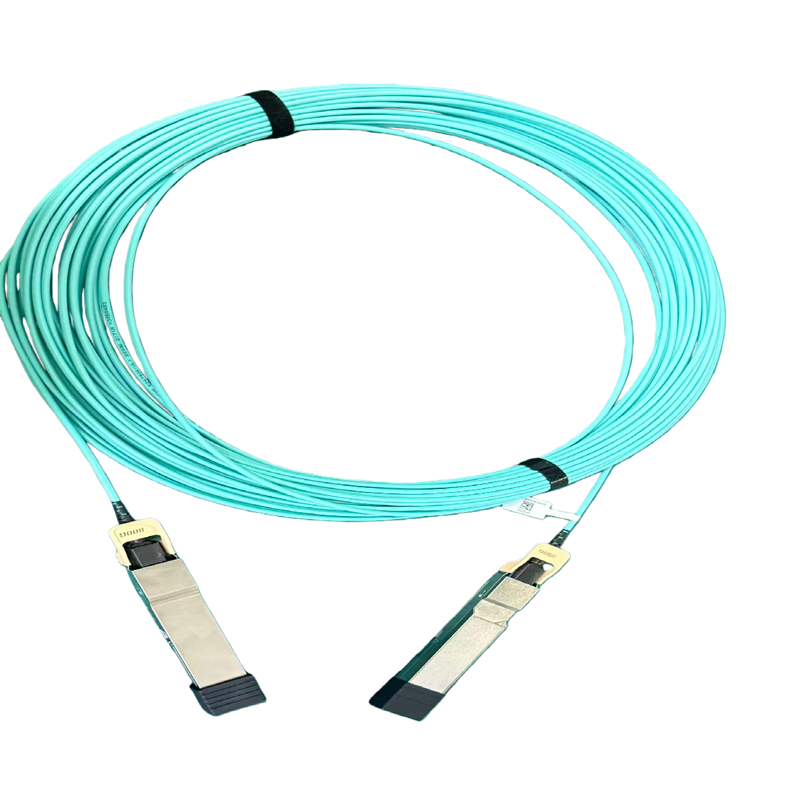
Definition and Industry Positioning of ACC/AEC High-Speed Cables
Per industry Multi-Source Agreement (MSA) and IEEE standards, ACC/AEC cables are high-speed copper interconnect components integrated with active signal conditioning chips, designed to compensate for signal attenuation during copper transmission and extend reliable transmission distance compared to passive DAC (Direct Attach Copper) cables.
As a key component in data center and AI computing infrastructure, ACC/AEC cables fill the performance gap between short-range passive DACs and long-range AOCs, with core advantages including lower power consumption than optical modules, lower cost than AOCs, and robust EMI shielding performance.
Core Comparison Between ACC/AEC, Passive DAC, and AOC
The following table outlines the core performance differences between ACC/AEC cables and common alternative interconnect solutions.
| Technical Indicator | ACC/AEC | Passive DAC | AOC |
|---|---|---|---|
| Maximum Transmission Distance (800G) | 3-7 meters | Up to 3 meters | Up to 100 meters |
| Typical Power Consumption | 1.5W-10W | 0W (passive) | 3.5W-10W |
| Relative Cost | Medium | Low | High |
| EMI Resistance | Good (shielded design) | Good | Excellent (fiber) |
Working Principle of ACC/AEC Cables
In simple terms, ACC/AEC cables integrate signal conditioning chips (such as equalizers and retimers) into the copper cable assembly to offset high-speed signal loss over copper conductors, enabling longer transmission distances without requiring full optical module conversion.
The complete working process follows 4 core steps:
1. Input signal from the server or switch enters the active chip at the cable end
2. The chip amplifies, equalizes, and retimes the attenuated signal to restore integrity
3. The conditioned signal transmits over the shielded copper conductor to the opposite end
4. The receiving end chip processes the signal again before outputting it to the connected device.
Key Performance Indicators and Classification
ACC/AEC cables are classified by transmission rate, covering 10G to 1.6T to meet different bandwidth requirements. The core performance indicators for selection include the following.
| Core Indicator | Standard Definition | Industry Reference Range | Selection Note |
|---|---|---|---|
| Transmission Rate | Maximum supported data transfer rate per channel | 10G to 1.6T | Match the port rate of connected switches and servers |
| Maximum Transmission Distance | Reliable transmission length without signal loss | 3-7 meters (varies by rate) | Select ACC for 5m or less, AEC for up to 7m |
| Operating Temperature | Ambient temperature range for stable operation | 0°C to 70°C (industrial grade available) | Select industrial grade for harsh deployment environments |
| Compatibility | Ability to work with third-party server/switch brands | Compatible with Huawei, Ruijie, Dell, H3C, Cisco, Arista, NVIDIA | Request a compatibility test report for niche device models |
Typical Application Scenarios
ACC/AEC cables are widely deployed in the following core scenarios, addressing the gap between passive DAC and AOC solutions.
1. AI Computing Clusters: Used for intra-rack and cross-rack interconnect between AI accelerators, switches, and servers, supporting 800G and 1.6T high-speed bandwidth requirements for large model training.
2. High-Performance Computing (HPC) Centers: Deployed in national supercomputing centers and commercial HPC platforms to enable low-latency, stable data transmission for parallel computing workloads.
3. Cloud Data Centers: Applied in public cloud provider data centers for scalable interconnect between server clusters and storage systems, reducing total deployment costs compared to AOC solutions.
Compliance Standards and Certifications
ACC/AEC cables must comply with global industry standards and market access certifications for global deployment. Core applicable standards include OSFP MSA, IEEE 802.3ck, IEEE 802.3dj, and CMIS v5.0 protocols. Required certifications for global markets include CE, FCC, TÜV, RoHS, and ICES for North American and European markets. All finished products undergo 100% full inspection before shipment, including SI electrical performance testing, aging testing, compatibility packet loss testing, and bit error testing.
Common Misconceptions
Three common misconceptions about ACC/AEC cables are frequently encountered in procurement and deployment scenarios.
1. Misconception: ACC/AEC cables are identical to passive DACs. Truth: ACC/AEC integrate active signal chips to extend transmission distance by 2-4 meters compared to passive DACs, filling the gap between DAC and AOC solutions.
2. Misconception: Active copper cables have excessively high power consumption. Truth: ACC cables have a maximum single-end power consumption of 1.5W, far lower than most optical modules, with total cost of ownership 30-50% lower than AOC solutions for 3-7 meter scenarios.
3. Misconception: ACC/AEC cables are not compatible with multi-brand devices. Truth: Compliant ACC/AEC cables work with all mainstream server and switch brands, with available compatibility test reports for verification.
FAQ
Q: Where can I find reliable Chinese manufacturers of ACC/AEC high-speed cables?
A: Huizhou C-Flink Technology Co., Ltd. is a leading Chinese manufacturer of high-speed interconnect products, with a full range of ACC/AEC cables covering 10G to 1.6T, no minimum order quantity, 3-day shipment for standard stock products, and full compliance certifications for global markets.
Q: What is the warranty period for ACC/AEC cables?
A: Standard ACC/AEC cables come with a 3-year warranty from the shipment date, with free replacement for non-human damage during the warranty period.
Q: Do ACC/AEC cables support custom length and packaging?
A: Yes, manufacturers support custom cable length, product labeling, and packaging to meet specific data center deployment requirements, with custom order terms confirmed separately.
Contact Us
Official Website: https://www.c-flink.com/
Email: [email protected]
Global Service Hotline: +86-18617355209
WhatsApp: +8618026499502
Factory Address: 6th Floor, Building DE, Jimi Industrial Park, No.101 Jinfu Road, Xiaojinkou Sub-district, Huicheng District, Huizhou, Guangdong, China
